
Fleet Rocket
A TMS built for the crossing, not adapted to it.
How Fleet Rocket works
Capture the whole shipment, not just a truck.
One movement from Monterrey to Dallas runs in three legs, each with its own carrier. The crossing leg closes and the next one takes over, all on one record.
Status changes come off geofences rather than phone calls. When the proof of delivery lands, the CFDI 4.0 invoice is stamped inside the system; if the PAC rejects it, it is reprocessed and keeps its original folio.
An illustration seen from above. A Mexican carrier picks up a load at a plant in Monterrey and drops it at a border yard in Nuevo Laredo. A crossing carrier picks it up there, crosses the border and drops it at a yard in Laredo, where a US carrier takes it on toward Dallas. Each yard has a geofence that lights up as trucks enter, and each handoff is reported to Fleet Rocket. When the proof of delivery arrives, the CFDI invoice is sent to the PAC, rejected once, reprocessed and stamped with the same folio. A shipment record on screen follows the three legs, the documents and the invoice.
Illustrative scene. Shipment numbers, carriers, plates and timings are representative of a Monterrey–Dallas movement through Nuevo Laredo.
A transport management system for cross-border and nearshoring operations across Mexico, the United States and Canada, where one movement can involve several carriers, a customs broker and a border warehouse — and usually does.
- Implementation time
- < 7 days
- Free trial on the entry plan
- 15 days
- Demo, from shipment to stamped CFDI
- 30 min
01
Post the load, and a carrier takes it.
A load goes on the loadboard with no carrier assigned. Assign one directly, or post it to the marketplace with a maximum offer: the first carrier to bid at or below it wins the load. Zayren, built into Fleet Rocket, supplies the market rate and ranks the carriers on that lane.
Matching carriersCarrier matched
02
Capture the whole shipment, not just a truck.
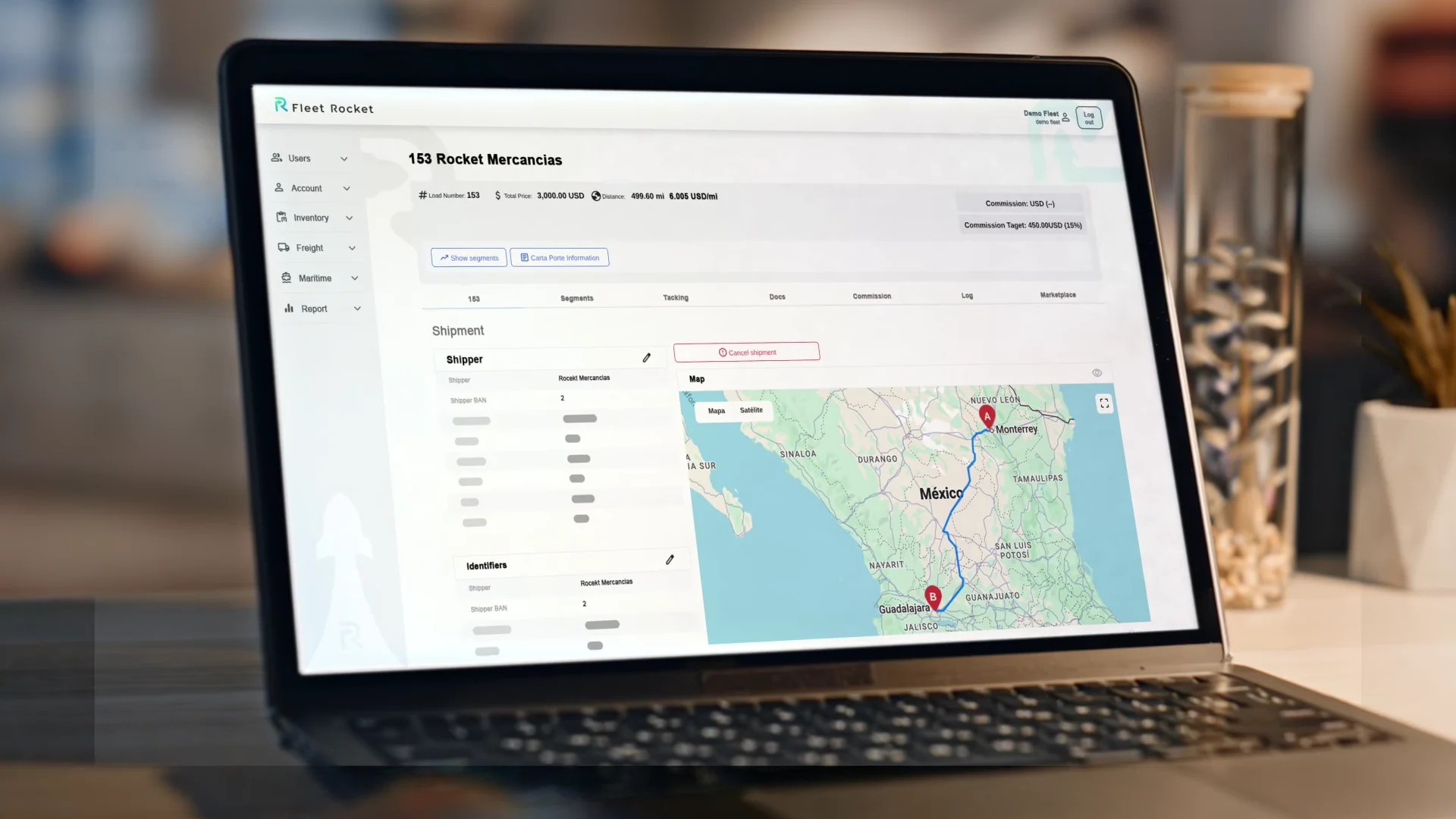
A cross-border shipment is not a single truck; it has legs — usually three across the border, each with its own carrier, plates and status. Manage them all in a single record.
Crossing leg in transitHanded off — onward leg running
03
One record: tender to payment.
The load, carrier, Carta Porte, proof of delivery and location, all on one record. Status updates and invoicing are automatic once the documentation is confirmed.
- Carrier
- FR8-2841
- Equipment
- FTL · Dry Van
- Pickup
- 10/11 23:35 CST
- Delivery
- 10/12 20:00 CST
Documents
Position via Fr8Radar
Settlement held — no proof of deliveryVerifying proof of deliverySettlement can run
04
A rejected invoice is not a lost invoice.
CFDI 4.0 stamping runs inside the system, against an authorised PAC. When the tax authority rejects one it is reprocessed and comes back stamped with its original folio intact — which is the part of compliance an operator actually worries about.
Issuer
FR8-TENANT-02
Receiver
FR8-9004
Freight service · Monterrey → Dallas
Load 31-1
- Subtotal
- $ 24,051.72
- VAT 16%
- $ 3,848.28
- Total
- $ 27,900.00
Cross-border transport management
Fleet Rocket is the product the pivot rests on. Companies licence it and run it themselves: Salzillo holds a multi-year SaaS licence, Accel Logística signed a two-year contract and Marksman signed a two-year agreement in February 2026 — all three operating the system rather than buying a service.
It coordinates tender, acceptance, assignment and settlement against a single shipment record, with Fr8Radar supplying position underneath it and Zayren supplying the rate. Status changes come off geolocation rather than off a phone call, and when the fleet runs out the load goes to the marketplace from the same loadboard.
The part a TMS built for the American market does not carry: CFDI 4.0 stamping and payment complements run inside the system, against an authorised PAC, with the shipment’s own figures already on the invoice. The alternative is leaving the TMS for a PAC portal and typing the same numbers a second time.
What it does
01
One movement, several carriers
A crossing can carry a Mexican carrier, a US carrier, a customs broker and a border warehouse on one record instead of on four.
02
Status off geolocation
Position from Fr8Radar’s integrated providers moves the shipment through its own statuses. Nobody calls a driver to ask where the truck is.
03
Native CFDI 4.0 stamping
Income CFDIs and payment complements issued from the completed shipment against an authorised PAC — including cancellations, IVA by traffic type, and series and folio per client.
04
Carta Porte and customs paperwork
Carta Porte generated per shipment; PODs and bills of lading read and checked by model before anyone files them.
05
Your clients on it, under your name
Shipper accounts are unlimited on every plan and custom branding is included on all of them. Team seats are what scales with the tier — four on the entry plan, unlimited on Enterprise.
06
Cash before the customer pays
Invoices financed inside the platform through Solvento, a SOFOM regulated by the CNBV, so a delivered load need not wait out a payment term.
07
Licensed, not rented
Enterprises operate their own instance, wired to the ERP or CRM they already run through the API. This is the direction the company is going.
The states a load moves through
One shipment record from creation to settlement. These are the system’s own statuses, not a simplification of them.
- Created
The load exists. Nothing is committed to a carrier yet.
- Posted
Offered to the carrier network and waiting on a match.
- Load matched
A carrier is assigned and the move is committed.
- Unloaded with POD
Delivered with proof attached. Settlement can run.
- Unloaded without POD
Delivered, evidence missing. This is the state that holds an invoice.
- Canceled
Closed without a move.
Wired to
 ZayrenAI agents for capacity, rates and negotiation
 Fr8RadarAn AI logistics control tower
 Fr8AppDigital brokerage and transportation marketplace
Real dependencies, not a list of everything the company sells. Each of these either feeds this product or is fed by it.
What it takes to get it running
A TMS purchase has no number attached to the part a buyer actually worries about — how long before anyone is using it. These are the product’s own published answers.
A trial before anyone signs anything
Fifteen days on the entry plan, opened from the product’s own site. There is no integration project standing in front of it and no card to hand over first.
A demo in thirty minutes
The length the product itself quotes to walk the invoicing flow from a completed shipment through to a stamped CFDI.
Live in under seven days
The published implementation time — and setup and initial training come with every plan, including the cheapest one.
And it travels
A free app for owner-operators, small carriers and dispatchers: find and book loads, assign drivers, tractors and trailers, move a status, upload the documents.
Frequently asked
Questions about Fleet Rocket.
How long does it take to get it running?
The published implementation time is under seven days. Setup and initial training come with every plan, including the entry one.
Can we try it before signing anything?
Yes. The entry plan has a fifteen-day free trial, opened from the product’s own site, with no integration project in front of it and no card to hand over first.
Does it issue Mexican tax invoices?
Yes. CFDI 4.0 stamping and payment complements run inside the system, against an authorised PAC, with the shipment’s own figures already on the invoice. Carta Porte is generated per shipment.
Can one shipment carry more than one carrier?
Yes. A crossing can carry a Mexican carrier, a US carrier, a customs broker and a border warehouse on one record instead of on four.
Does it connect to the systems we already run?
Enterprises operate their own instance, wired through the API to the ERP or CRM they already use.
See Fleet Rocket running on your operation.
The rest of the lineup
A Freight Technologies product · Nasdaq: FRGT